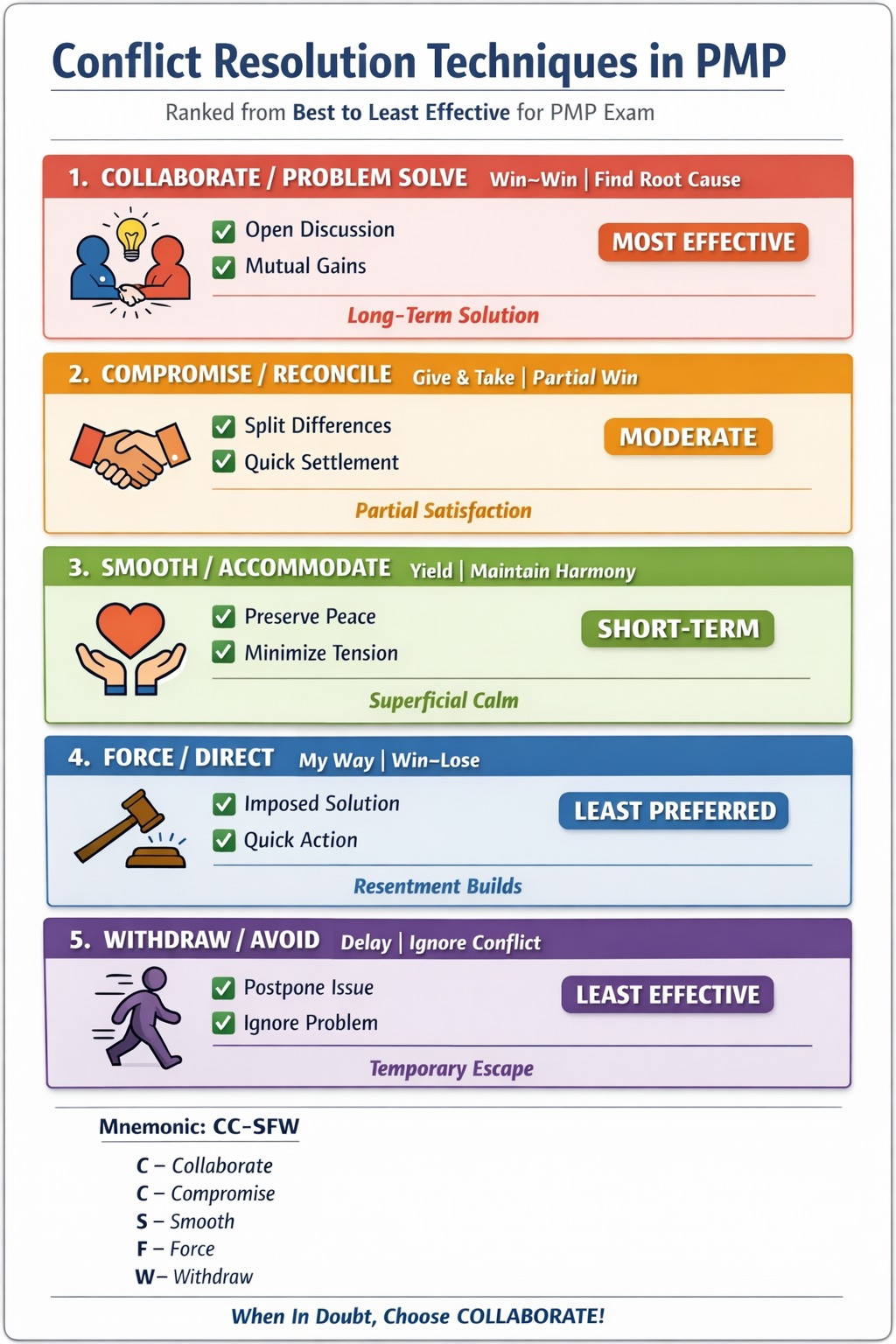
“Every unresolved conflict is a hidden tax—quietly draining performance, eroding trust, and delaying results.”
“Most workplace conflicts don’t need mediation. They need better leadership decisions.”
Conflict isn’t dysfunction. Conflict Management is an Art? It’s data.
· Handled well, it accelerates decisions.
· Handled poorly, it silently kills momentum.
Here are 5 common conflict situations—and ?how expert leaders respond?
1. The Technical Approach Deadlock
Situation: Two senior engineers. Two strong opinions.
• One backs a stable legacy build
• The other pushes cloud-native scalability
Strategy: Collaborate (Win–Win) : This is the gold standard. A strong PM facilitates facts over opinions, integrates multiple viewpoints, and drives shared ownership of the final architecture.
Leadership Insight: Great leaders don’t choose sides—they design better options.
2. The Resource Scarcity Tug-of-War
Situation: A functional manager wants your critical-path developer—right when your project can’t afford it.
Strategy: Compromise (Lose–Lose, Temporarily)
>When both sides have valid needs, partial sacrifice beats total failure.
>Example: time-boxed allocation, short-term split focus.
Leadership Insight: Compromise isn’t weakness—it’s pragmatism under pressure.
3. The “Done… but Not Really” Conflict
Situation: Sprint Review friction. The team followed the user story, yet the Product Owner is dissatisfied.
Strategy: Facilitate with Transparency
>Shift from who failed to what was unclear.
>Refine the Definition of Done. Make expectations explicit.
Leadership Insight: Most Agile conflicts are not delivery failures—they’re alignment failures.
4. The Emergency Directive
Situation: A sudden regulatory or compliance change threatens the project’s existence.
Strategy: Force / Direct (Win–Lose)
>This is not collaboration time.
>This is decisive leadership.
Leadership Insight: Exceptional leaders know when consensus is a luxury they can’t afford.
5. The Personality Clash
Situation: Personal friction is spilling into stand-ups, slowing the entire team.
Strategy:
>Smooth initially to de-escalate
>Withdraw temporarily if emotions are high
> Address root causes privately and professionally
Leadership Insight: Not every conflict needs a stage. Some need space and maturity.
The Expert Takeaway: High-performing teams don’t have less conflict. They have better conflict. >They challenge the “How” and the “What”— Never the “Who.”
>Conflict isn’t the enemy. Poor conflict management is.
hashtag#Leadership hashtag#ProjectManagement hashtag#PMIPMP hashtag#PMIACP hashtag#AgileLeadership hashtag#ConflictManagement hashtag#HighPerformanceTeams hashtag#TransformationLeadership,